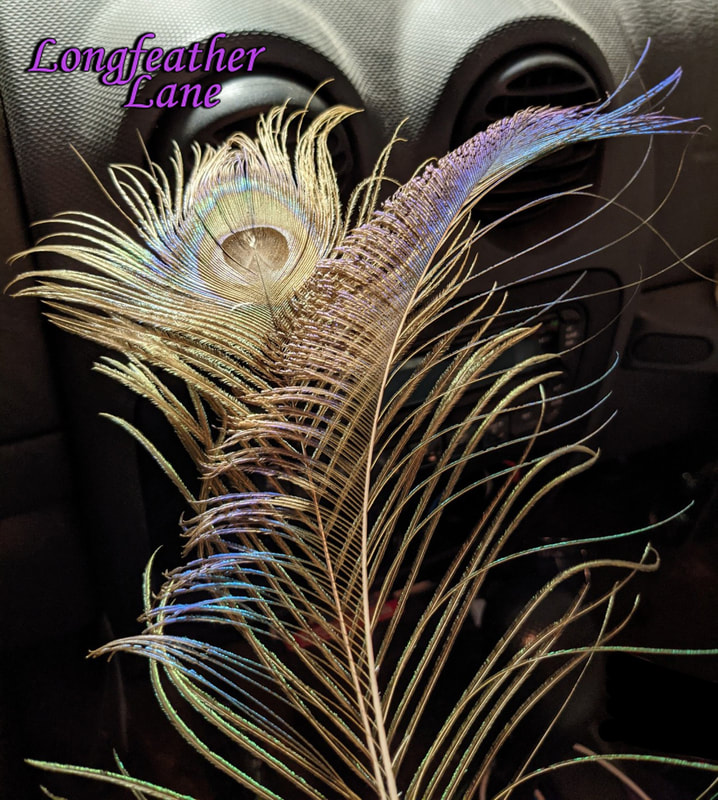
Iridescence in feathers
Peafowl take their non-black/brown colors from structural iridescence. This means that the colors like blues and greens and reds and golds etc seen on peafowl necks and trains and wings are not pigments. They're produced from refracted light bouncing around in the structure of the feather barbs and barbules.
Over time, through general wear and use, as well as from UV (sun exposure), the feathers degrade. The structures begin to break down, and the light refracts differently. This is why a peacock's train looks more red in the winter (when the structures are all intact) and very green or even green-gold by the end of the season. It's also why a purple peacock's train often appears green at the start, and brown by the end; their structures have broken down almost entirely by the time of molt.
Melanin breaks down slower due to sun exposure than other pigments, which is why mutations with black in their base will hold their color better and longer than paler mutations, which tend to look very sun-bleached by molt. It also accounts for the difference between a "southern" peach and a "northern" peach despite there likely being no particular genetic difference. A peach bird exposed to a lot of sun - like one would see in the south USA - will be paler by comparison than a peach raised in climates with less sun - like one would see in many places in north USA.
Over time, through general wear and use, as well as from UV (sun exposure), the feathers degrade. The structures begin to break down, and the light refracts differently. This is why a peacock's train looks more red in the winter (when the structures are all intact) and very green or even green-gold by the end of the season. It's also why a purple peacock's train often appears green at the start, and brown by the end; their structures have broken down almost entirely by the time of molt.
Melanin breaks down slower due to sun exposure than other pigments, which is why mutations with black in their base will hold their color better and longer than paler mutations, which tend to look very sun-bleached by molt. It also accounts for the difference between a "southern" peach and a "northern" peach despite there likely being no particular genetic difference. A peach bird exposed to a lot of sun - like one would see in the south USA - will be paler by comparison than a peach raised in climates with less sun - like one would see in many places in north USA.
Feather Photos
The images below are clear, up-close images of feathers not attached to the birds.